
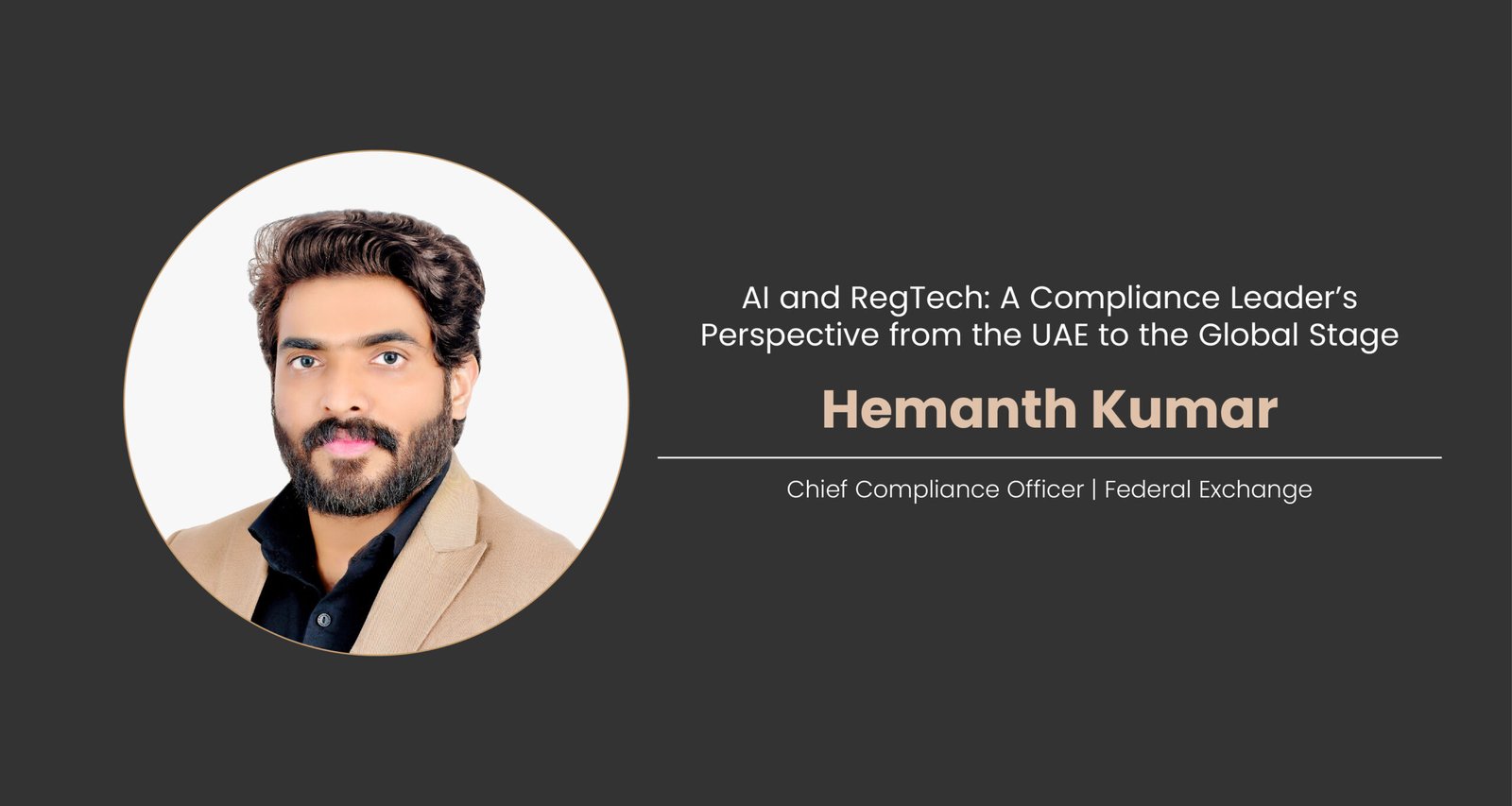
AI and RegTech: A Compliance Leader’s Perspective from the UAE to the Global Stage

I am Hemanth Kumar, currently serving as Chief Compliance Officer at Federal Exchange in the United Arab Emirates. Over the last 15 years, I have worked across compliance, risk management, and regulatory technology, spanning the UAE, India, Hong Kong, Singapore, and the UK. I hold certifications including CAMS, CRCMP, ICA Specialist in AI Compliance, and CCE (Crypto Expert).

Much of my career has been shaped by exposure to global standards FATF framework and its application across regions. I have also had the privilege of contributing thought leadership on compliance and technology innovation, including perspectives on RegTech and AI integration.

As someone deeply engaged with both traditional financial frameworks and emerging regulatory expectations in the virtual asset space (under regulators such as VARA and ADGM), I approach compliance not only as a rulebook-driven responsibility but as a human-led mission to safeguard trust in financial systems.

The Evolving Compliance Landscape

In today’s globalized economy, compliance is no longer a back-office function — it is a strategic pillar of organizational resilience. FATF standards have created a common global language, but implementation varies widely across jurisdictions.

The UAE, where I currently practice, has emerged as a regional hub by aligning with FATF’s evolving expectations. The country’s removal from the FATF grey list in 2024 was not accidental — it was the result of targeted reforms in supervision, risk-based approaches, and cross-border cooperation.

What this demonstrates is simple: compliance is no longer just about “following the rules.” It is about proving effectiveness, demonstrating that systems and processes are not only in place but are actually preventing illicit financial flows.

Yet the challenge remains: the sheer scale and complexity of transactions in a borderless financial system make it humanly impossible to monitor risks without technological augmentation. This is where RegTech and AI enter the conversation.

AI as a Game-Changer in Compliance

Artificial intelligence is not science fiction in compliance — it is already here. From sanctions screening to transaction monitoring, from biometric onboarding to predictive analytics, AI is rewriting the way institutions detect, assess, and mitigate risks.

Take sanctions screening as an example. Traditional systems often generate overwhelming false positives, consuming valuable analyst hours. AI-driven alert calibration, on the other hand, can reduce false positives by learning patterns, refining rules, and highlighting true risks with higher accuracy.

Similarly, in transaction monitoring, AI modules can detect anomalies that rule-based engines miss — such as hidden layering in cross-border remittances or crypto-to-fiat conversion risks. AI’s predictive capability enables compliance teams to move from reactive investigations to proactive prevention.

But here lies the caution: AI is not infallible. Algorithmic bias, lack of explainability, and over-reliance on automation can create blind spots. In my experience, the most effective compliance programs are those that treat AI not as a replacement for human judgment but as an enhancement of it.

RegTech and Human Judgment: Striking the Balance

RegTech has transformed compliance efficiency, but technology alone cannot safeguard integrity. I often remind my teams that systems are only as strong as the values of the people who design, monitor, and interpret them.

Over the years, I have seen cases where institutions invested heavily in systems yet failed compliance audits — not because the technology was inadequate, but because governance, accountability, and ownership were missing.

This is where ideology and leadership matter. Compliance leaders must ensure that RegTech solutions are not simply deployed but meaningfully integrated into a culture of responsibility. AI can scan millions of transactions in seconds, but it takes a human leader to ask: Are we asking the right questions? Are we willing to act when the answers are uncomfortable?

For me, the intersection of technology and human ethics is where the true future of compliance lies.

Global Lessons from the UAE Corridor

Working in the UAE has given me a front-row seat to one of the most dynamic regulatory environments in the world. The UAE is unique because it must manage traditional banking, sprawling remittance corridors, and the fast-emerging virtual asset ecosystem simultaneously.

When FATF called for stronger action, the UAE responded with entity-wide risk assessments, strengthened sanctions frameworks, and dedicated virtual asset regulations through VARA. These were not mere check-the-box exercises — they were structural changes aimed at embedding compliance into the DNA of institutions.

For example, under VARA, Virtual Asset Service Providers (VASPs) must demonstrate not just KYC procedures but ongoing monitoring, transaction surveillance, and travel rule compliance. This mirrors FATF’s Recommendation 15 but adds a local layer of accountability tailored to Dubai’s market.

The lesson for global compliance leaders is clear: adopting FATF standards is not enough. Each jurisdiction must adapt those standards to its unique risk environment, and each institution must internalize them as part of daily operations.

Future Outlook: AI, Trust, and the Human Role

As compliance professionals, we often discuss what technology can do. I believe the next conversation must also focus on what technology should not do.

AI should not replace the ethical compass of human judgment. AI should not dilute accountability by allowing leaders to defer responsibility to algorithms. And AI should never become an excuse for complacency in governance.

The future of compliance will be defined by hybrid models — where AI provides the speed, scale, and precision, and humans provide the judgment, values, and courage to act. Regulators, too, are evolving. The EU’s AI Act, for instance, requires explainability and accountability in high-risk AI applications. This is a reminder that even as we innovate, we must remain transparent.

For me, the essence of leadership in this space is about more than compliance. It is about trust. Institutions that use AI responsibly, transparently, and ethically will not only satisfy regulators — they will earn the confidence of customers, partners, and the global community.

Conclusion

We are entering a new era where compliance cannot be separated from technology, and technology cannot be separated from values.

AI and RegTech will continue to redefine the efficiency of compliance programs, but they cannot replace the role of ethical leadership. At the end of the day, compliance is not about machines or systems — it is about people protecting people, safeguarding economies, and preserving the integrity of global financial systems.

As someone who has lived through audits, regulatory reforms, and cross-border challenges, my conviction is simple: AI is an enabler, but human leadership is irreplaceable.
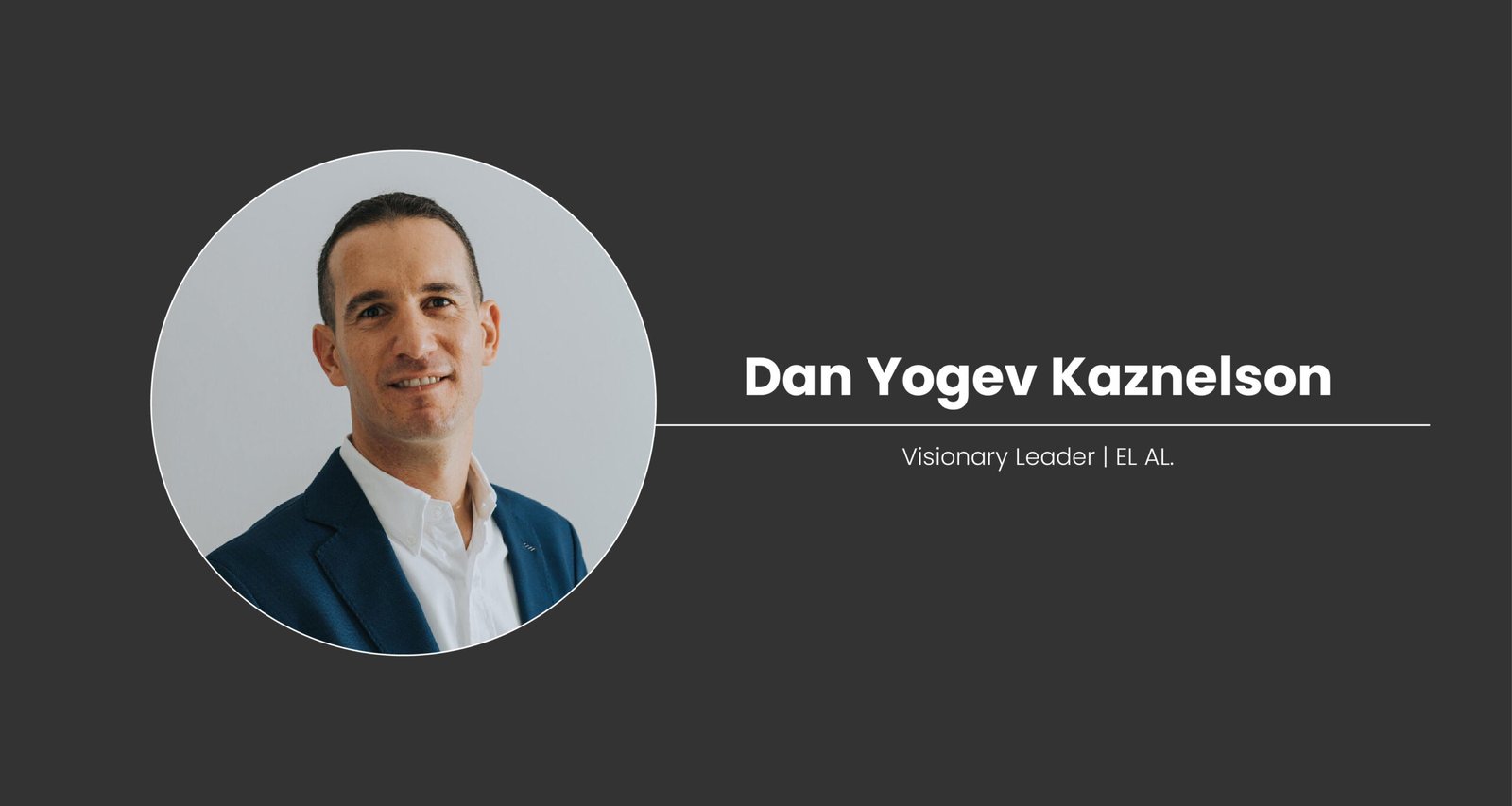
 

An Interview with Dan Yogev Kaznelson of EL AL Israel Airlines

Dan Yogev Kaznelson is a visionary leader in the aviation industry, currently driving digital and operational innovation at EL AL. With a background in IT and project management, he has built a career around leveraging technology to transform complex systems and enhance efficiency. His leadership style emphasizes collaboration, inclusivity, and empowering teams to co-create impactful solutions. Under his guidance, EL AL has embraced digitalization, AI-driven tools, and customer-centric innovations to stay competitive in a rapidly evolving market. Widely respected for bridging technology and people, Dan continues to shape the future of aviation with strategic foresight and a passion for meaningful impact.


Here are the key highlights from the interview:

1. Can you share the story of your professional journey and what inspired you to pursue a career in the aviation industry?

My career has been driven by a passion for technology, problem-solving, and operational excellence. I began in project management and IT, where I discovered how digital solutions can transform complex environments. Aviation stood out because it’s a truly complex industry with multiple interconnected systems, where every day is different and no two days are the same. It’s an environment that constantly demands flexibility and the ability to react quickly to change, which aligns perfectly with my interest in strategic thinking and innovation. The opportunity to apply technology to create meaningful impact across people and operations inspired me to dedicate my career to this dynamic field.

2. How did your early experiences shape your leadership style and vision for driving innovation at EL AL?
Early in my career, I realized that successful leadership is about listening as much as directing. Working in project management and IT taught me to understand people’s perspectives, involve them in shaping solutions, and harness their potential. I also developed a habit of asking key questions for every initiative: What value does this bring? How will it benefit the organization? At EL AL, this approach drives inclusive innovation, where employees are active participants in valuable projects. I maintain an open mind, encouraging everyone to share new ideas, because those closest to the work often have the best insights. By building strong partnerships across teams and fostering open dialogue, I’ve learned that sustainable innovation emerges when people feel empowered, engaged, and part of the journey.

3. What drew you specifically to focus on aviation and airline management, and how has your role evolved over time?
Aviation drew me because it’s a highly complex, dynamic industry where multiple systems interact, and no two days are ever the same. It challenges you to react quickly to change and make decisions that ripple across the entire organization. I initially focused on IT and digital projects, but over time my role has evolved to overseeing broader operational and digital strategies, integrating technology and processes. Several projects have also improved the employee experience, which in turn has had a positive impact on the passenger experience. Today, I work to enhance efficiency and ensure EL AL remains innovative, agile, and future-ready.

4. How has EL AL adapted its services to meet the evolving expectations of travelers and the changing dynamics of the aviation industry?

EL AL has embraced innovation, digitalization, and AI-driven solutions to meet the evolving expectations of passengers. We have introduced new services and self-service options that make the travel experience more convenient, flexible, and personalized. At the same time, we continuously improve operational processes, enabling smarter decision-making and more efficient day-to-day operations. Passengers now receive real-time updates and enhanced support, reflecting our commitment to seamless, technology-enabled experiences. By combining these elements, EL AL stays agile, innovative, and ahead in a competitive aviation landscape.

5. What were the most significant challenges you faced in leading within such a highly competitive and regulated industry, and how did you overcome them?

One of the greatest challenges in aviation is leading transformation in a highly regulated and competitive environment. Regulatory requirements, complex systems, and naturally cautious mindsets often make change difficult. I overcame this by learning from leading companies in the industry, drawing insights from colleagues at other airlines, and approaching problems with creative, out-of-the-box thinking. At the same time, I emphasized collaboration, building strong partnerships across departments, and fostering open dialogue, ensuring that every change was understood, embraced, and delivered clear value. This approach has proven essential in driving successful innovation in a complex environment.

6. How do you ensure EL AL remains competitive and relevant in a fast-changing global aviation landscape?

To stay competitive, EL AL focuses on continuous innovation, operational excellence, and customer-centric solutions. We invest in digital tools, AI-driven systems, and self-service platforms that enhance efficiency and improve the passenger experience. At the same time, we nurture a culture of collaboration, learning, and agility, ensuring that new ideas are tested, refined, and implemented effectively. By combining strategic technology adoption with strong operational practices, EL AL remains adaptive, resilient, and positioned to lead in a rapidly evolving global aviation market.

7. What advice would you give to young professionals who aspire to build a career in aviation and airline management?

For young professionals aspiring to a career in aviation, I would advise them to remain curious, embrace challenges, and think boldly. Seek opportunities to learn and make a meaningful contribution by addressing problems, and take lessons from both successes and setbacks while maintaining adaptability in a fast-paced industry. Cultivate relationships and surround yourself with individuals who challenge you and help you achieve your full potential. Above all, strive to make a tangible impact—through innovation, collaboration, practical engagement, and persistence in bringing ideas to fruition.

9. How do you see the aviation industry evolving over the next 5–10 years, and what role do you envision EL AL playing in shaping that future?

The aviation industry will continue to experience strong growth over the next decade, driven by rising passenger demand and global connectivity. Digitalization will play a central role, with intelligent, data-driven systems, AI, self-service solutions, and flexible platforms transforming how airlines operate and anticipate passenger needs. EL AL has already initiated its digital transformation, and as an Israeli company in the “Startup Nation,” we are committed to adopting emerging technologies and becoming a fully digital airline. Our focus is on delivering efficient, seamless, and personalized experiences, while leading the next generation of innovation and shaping the future of aviation.

10. How would you like your leadership and contribution to the aviation sector to be remembered?

I hope to be remembered as a leader who bridged technology and people, turning innovative ideas into meaningful impact. My goal has always been to improve operational processes, enhance experiences, and empower teams to perform at their best. I want my contribution to reflect a commitment to innovation, collaboration, and practical results, leaving a legacy that not only advanced EL AL but also helped shape the broader aviation industry for the better.

11. Is there anything specific you would like to highlight about EL AL’s journey, achievements, or impact that you feel would inspire our readers?

EL AL’s journey in recent years demonstrates the power of vision, innovation, and perseverance. Following the challenges of COVID, EL AL rebuilt itself as a new-generation airline, redefining how we operate and serve our passengers. Projects I have led—such as EFF, Trip Trade, ACC and many more—have showcased how strategic technology adoption can transform operations and drive efficiency, with several receiving international recognition and awards. Beyond these achievements, EL AL has consistently maintained 5-star customer service ratings across multiple years, a testament to our dedication to excellence. Together, these milestones highlight what is possible when technology, people, and strategy align, and I hope they serve as inspiration for others to embrace innovation and create meaningful impact in their own industries.