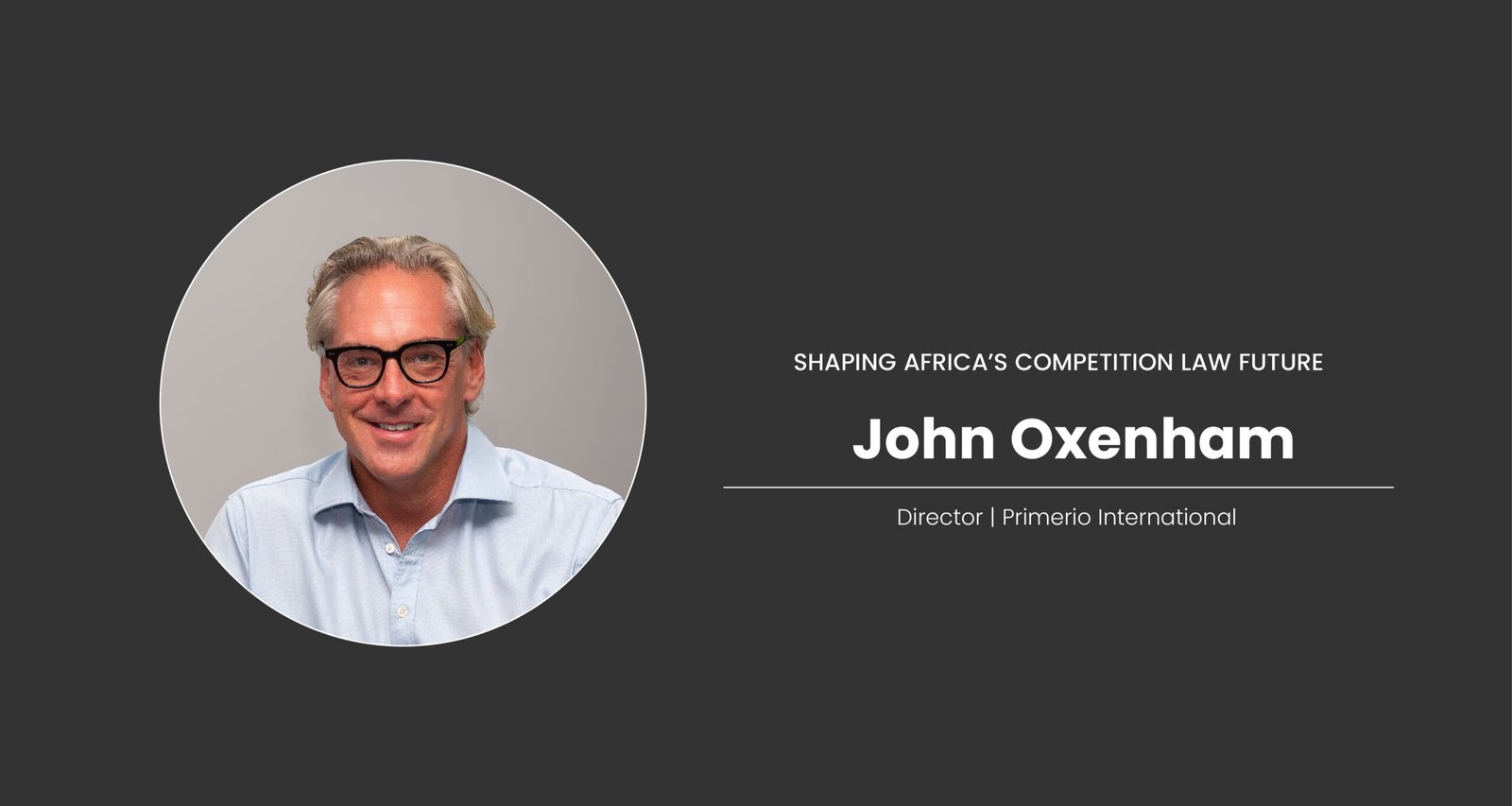
As Africa’s markets become more interconnected and regulatory scrutiny deepens, competition law has emerged as one of the most influential forces shaping business strategy across the continent. At the centre of this evolution stands John Oxenham, Founder and Managing Partner of Primerio International, a firm that has redefined how competition and regulatory law is practised in Africa. With a career spanning Johannesburg, Washington, D.C., and multiple African jurisdictions, Oxenham has built a pan-African legal platform grounded in principle, technical excellence, and a clear strategic vision.
Johannesburg Origins and the Foundations of Discipline
Born and raised in Johannesburg, Oxenham’s professional journey is deeply influenced by his South African roots. His formative education, which included time in England and later at the University of Cape Town, played a defining role in shaping his character and approach to the law. Exposure to different educational systems instilled resilience, discipline, and focus qualities that would later prove essential in navigating complex regulatory and cross-border legal environments.
These early experiences also fostered an appreciation for both structure and adaptability. For Oxenham, law was never simply about doctrine; it was about understanding how rules operate in real economies and how institutions evolve over time.
Building Expertise at Webber Wentzel
Oxenham began his legal career at Webber Wentzel, one of South Africa’s most prominent law firms. Specialising in competition law, he entered the field at a time when South Africa’s antitrust regime was gaining prominence and enforcement agencies were asserting their authority.
During this period, Oxenham developed a strong technical foundation in merger control, restrictive practices, and abuse of dominance. More importantly, he gained early exposure to the strategic dimension of competition law how regulatory decisions can reshape industries, influence investment, and alter market behaviour.
A Global Perspective: Washington, D.C.
Seeking to broaden his expertise, Oxenham moved to Washington, D.C., where he worked as a foreign antitrust adviser at Howrey LLP. Immersed in one of the world’s most sophisticated antitrust environments, he was exposed to complex investigations, advanced economic analysis, and high-stakes cross-border matters.
This experience proved transformative. It provided Oxenham with a global benchmark for regulatory practice and reinforced the importance of independence, rigorous analysis, and credibility with enforcement agencies. Crucially, it also highlighted the absence of comparable, integrated competition law platforms in Africa an insight that would later inform his entrepreneurial vision.
Returning Home: Partnership and Entrepreneurial Drive
On returning to South Africa, Oxenham became a partner at Webber Wentzel and later co-founded a specialist practice focused on competition law and complex disputes. His reputation continued to grow, but so did his conviction that Africa’s legal market needed a new model one capable of addressing cross-border regulatory challenges in a coordinated and consistent manner
Africa’s economies were integrating, regional competition authorities were becoming more assertive, and multinational clients were seeking clarity across multiple jurisdictions. The traditional, fragmented approach was no longer sufficient.
The Founding of Primerio: A Pan-African First
In 2014, Oxenham developed the concept of Primerio as a dedicated pan-African competition and regulatory boutique. Two years later, the firm commenced trading as Africa’s first specialist pan-African competition law firm a bold and unconventional move in a profession often dominated by full-service firms.
Primerio’s structure was deliberately designed for cross-border work. By 2021, the firm had established its operational headquarters in Johannesburg, supported by regional hubs in Mauritius and Kenya. Today, Primerio advises across Southern, East, West, and North Africa, as well as before regional authorities such as COMESA, ECOWAS, and CEMAC.
Core Principles: African Roots, Global Standards, Genuine Diversity
Primerio’s growth has been underpinned by a clear set of values. The firm is grounded in African roots, ensuring that advice is informed by local regulatory realities and enforcement cultures. At the same time, it operates according to global standards, drawing on international best practice in competition, investigations, and regulatory advisory work.
A defining feature of the firm is its commitment to genuine diversity. Primerio’s teams reflect different legal traditions, languages, and cultural perspectives from across the continent. This diversity is not symbolic; it enhances the quality of analysis and enables the firm to operate seamlessly across jurisdictions.
Advocacy is another cornerstone of the firm’s identity. Primerio actively engages in policy dialogue and regulatory development, recognising that sound frameworks ultimately benefit both markets and clients.
Africa’s Evolving Regulatory Landscape
Oxenham believes Africa is entering a decisive phase in its regulatory development. Competition regimes at both national and regional levels are becoming more sophisticated, with increased coordination and enforcement activity. Digital markets, platform economies, and data-driven business models are placing new demands on traditional competition law tools.
At the same time, there is a growing convergence of competition law, trade policy, and anti-corruption enforcement. Heightened scrutiny around bribery, money-laundering, and asset recovery has increased the global risk profile for businesses operating in Africa. Regulatory exposure is no longer confined to a single jurisdiction; it is increasingly cross-border and reputational.
Managing Cross-Border Complexity
Primerio’s approach to complex, multi-jurisdictional matters is built on strategic coherence. Each matter begins with a single, integrated strategy, executed across jurisdictions through coordinated teams.
Operating from regional hubs, the firm combines competition, regulatory, white-collar, and trade expertise with in-house economists and former regulators. Matters are centrally led, while trusted local counsel ensure alignment with domestic legal and enforcement nuances. Early risk assessment and proactive regulator engagement are critical elements of this model.
Leadership Philosophy: Specialist and Principled
Oxenham’s leadership philosophy is defined by focus and integrity. He has deliberately positioned Primerio as a specialist boutique, resisting expansion for its own sake. The firm concentrates on high-stakes competition, regulatory, investigations, and complex commercial work where it can deliver distinctive value.
Internally, Oxenham leads by example setting high technical standards, maintaining independence in difficult matters, and empowering younger lawyers with early responsibility. This approach has created a culture of accountability, excellence, and trust.
Ethics and Integrity at the Core
In areas such as competition enforcement, anti-corruption, and asset recovery, ethics are non-negotiable. Primerio routinely advises on anti-bribery, anti-money-laundering, internal investigations, and asset recovery, including through global networks such as ICC FraudNet.
The firm invests heavily in compliance frameworks and contributes to international initiatives like the ICC Antitrust Compliance Toolkit. Matters are carefully screened, conflicts rigorously managed, and instructions declined where independence could be compromised.
A Landmark Case That Shaped a Legacy
One of the most influential matters in Oxenham’s career was the South African bread cartel case, which led to the country’s first major follow-on damages and class action proceedings for cartel conduct. The case became a watershed moment in South African competition law, shaping jurisprudence on class actions and civil liability.
The experience inspired Oxenham to author Class Action Litigation in South Africa, the first textbook on the subject, reinforcing his belief in litigation as a driver of legal development and access to justice.
Mentorship and Building African Legal Talent
Mentorship is central to Primerio’s operating model. Lean, partner-led teams ensure that associates work directly on complex cross-border matters and engage with regulators early in their careers.
The firm actively promotes diversity and international exposure through exchanges, joint publications, and speaking engagements. Many of its younger lawyers are now recognised individually by international legal directories, reflecting the firm’s commitment to building world-class African legal talent.
Looking Ahead: A Long-Term Pan-African Vision
Oxenham’s long-term vision is for Primerio to remain the leading African-rooted competition and regulatory boutique, while preserving the agility and independence that define it today. Strategic priorities include deepening presence in key African markets, strengthening engagement with regional bodies, and continuing to invest in thought leadership and policy development. In an era of accelerating regulatory change, John Oxenham stands out as a legal leader shaping not only cases, but the very framework within which African markets operate.
- 📌 Visit John Oxenham 👉 – LinkedIn Profile
- 🌐 Explore Primerio International 👉 – Company Website